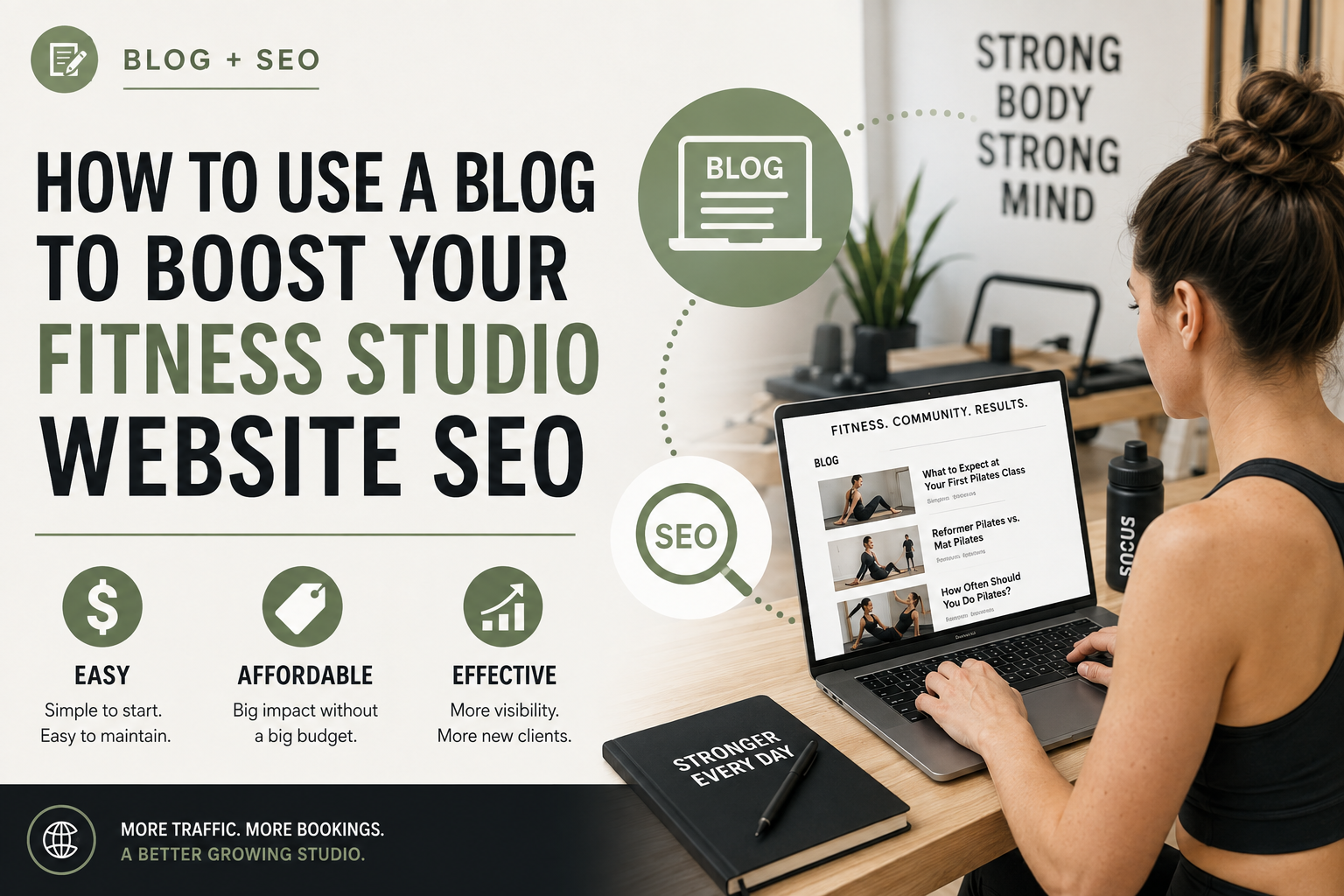
Your fitness studio website shouldn’t just look good, it should help new clients find you.
One of the simplest and most affordable ways to improve your website’s visibility on Google is also one of the most overlooked: blogging.
You don’t need to become a full-time content creator or publish something every week. A small library of useful, well-written articles can help your website show up for more searches, answer questions prospective clients are already asking, and build authority for your studio over time.
Here’s how it works, and how to make blogging manageable.
Why Blogging Helps Fitness Studio SEO
Think about how someone searches for a fitness studio.
They may search directly for:
- Pilates studio in Austin
- Reformer Pilates near me
- Spin classes in Denver
- Best yoga studio in Scottsdale
But those aren’t the only searches happening.
Potential clients are also asking questions like:
- What should I expect at my first Pilates class?
- Is reformer Pilates good for beginners?
- What should I wear to hot yoga?
- How often should I take Pilates?
- What’s the difference between Lagree and Pilates?
- How do I prepare for my first cycling class?
These searches create opportunities.
Your homepage and class pages can only cover so much. A blog gives your website additional pages that can answer these specific questions and appear in relevant search results.
Over time, those articles also help search engines better understand what your studio offers, where you operate, and what topics your website is an authority on.
Blogging Is More Affordable Than You Might Think
SEO can sound like something that requires a large marketing budget, an agency, or complicated software.
Blogging doesn’t.
If your website already has a blog, the primary investment is creating useful content. You can start with the knowledge your team already has.
Your instructors answer questions every day. Your front desk explains memberships, class formats, and what first-timers should expect. Your studio probably already creates educational content for Instagram, newsletters, or other marketing channels.
Much of that knowledge can become searchable website content.
And unlike a social post that may disappear from your audience’s feed within a few days, a useful blog article can continue attracting visitors through search for months—or even years.
What Should a Fitness Studio Write About?
Start with your customers, not with keywords.
Ask yourself: What does someone want to know before they book their first class?
Those questions are often some of your best blog topics.
For a Pilates studio, that might include:
- Reformer Pilates vs. mat Pilates
- What to expect at your first reformer class
- Pilates for beginners
- How often should you do Pilates?
- What to wear to Pilates
- Benefits of Pilates
- Private sessions vs. group classes
A cycling studio could cover first-ride preparation, cycling shoes, class intensity, recovery, or different class formats.
A yoga studio could create resources around beginner yoga, class styles, heated vs. non-heated classes, equipment, flexibility, or preparing for your first class.
The goal isn’t to write about everything related to fitness. Write about the subjects most closely connected to what your studio actually does.
Make Your Content Local
For a fitness studio, local visibility matters.
You generally don’t need thousands of website visitors from around the country. You need the right people in your market discovering your studio.
That makes local content particularly valuable.
Instead of only writing:
“A Beginner’s Guide to Reformer Pilates”
you might publish:
“A Beginner’s Guide to Reformer Pilates in Austin”
Where appropriate, naturally mention your neighborhood, city, instructors, studio, or local community within the article.
Don’t force your location into every sentence. Write naturally for a real person first, while giving search engines enough context to understand where your business operates.
Connect Your Blog to the Rest of Your Website
A blog shouldn’t be an island.
If you write an article explaining what someone should expect during their first Pilates class, link readers directly to your Pilates class page or schedule.
If you write about membership options, link to your pricing page.
If you mention a specific studio, link to its location page.
These internal links make it easier for visitors to take the next step while also helping search engines understand the structure and important pages of your website.
A simple path might look like:
Google Search → Helpful Article → Class Information → Schedule → Book
That’s where SEO becomes more than website traffic. It becomes part of your customer journey.
You Don’t Need to Post Every Week
Consistency is useful, but quality matters more than volume.
For most boutique fitness studios, publishing one or two genuinely useful articles per month is a much better strategy than trying to publish several low-quality posts every week.
Start with 10–20 questions your team hears regularly.
Turn each into an article.
You now have months of potential content without having to constantly brainstorm new ideas.
Even publishing once per month gives you 12 new searchable pages every year.
A Few Simple Tips for Better Results
Answer one clear question per article.
A focused article usually has a better chance of being useful than trying to cover an entire fitness category at once.
Use descriptive titles.
“5 Things to Know Before Your First Reformer Pilates Class” tells both readers and search engines exactly what the page is about.
Use headings.
Break longer articles into clear sections so visitors can quickly scan for the information they need.
Write like your studio.
SEO content doesn’t need to sound robotic. Your blog should still reflect your studio’s personality and expertise.
Include your location naturally.
Your city, neighborhood, and studio locations can provide important context for local searches.
Link to relevant pages.
Guide readers toward classes, instructors, pricing, locations, schedules, and other useful parts of your website.
Keep old articles updated.
If pricing, policies, class formats, or recommendations change, update the article rather than letting outdated information remain online.
Prioritize helpfulness over keyword stuffing.
You don’t need to repeat “Pilates studio Austin” 15 times. Write the best answer to the question and make the topic and location clear.
Turn Content You’re Already Creating Into Blog Posts
You may already have more blog content than you realize.
A strong Instagram caption can become the foundation of an article. A frequently asked question can become a 700-word guide. An instructor Q&A can become an educational post. A newsletter explaining a new class format can become an evergreen website resource.
One idea can also work across multiple channels:
Blog article → Email newsletter → Instagram post → Stories → Google Business Profile update
Instead of constantly creating more content, get more mileage out of the content you’re already producing.
Does Blogging Actually Work for Fitness Studios?
Blogging isn’t an overnight SEO trick.
A new article may take time to be discovered and gain visibility in search. But every useful article adds another relevant page to your website and another potential way for someone to discover your business. For the newer discovery context, see our guide to AI-assisted studio discovery.
Publish 20 useful articles answering questions about your services, classes, instructors, and local market, and your website now has 20 additional opportunities to meet potential clients while they’re searching.
That effect can compound over time.
And because the content lives on a website you control, you’re building an asset for your studio rather than relying entirely on paid advertising or social media algorithms.
Start Simple
You don’t need an elaborate content strategy to get started.
Pick five questions your studio gets all the time.
Choose one.
Write the clearest, most useful answer you can.
Add a few headings, link to the relevant pages on your website, include a clear next step, and publish it.
Then do it again next month.
SEO is rarely about finding one magic tactic. It’s about consistently making your website more useful, relevant, and discoverable.
For fitness studios, a simple blog is one of the easiest ways to start doing exactly that.
Build a Website That Can Grow With Your Studio
Your website should do more than provide basic information. It should help people discover your studio, understand what makes it different, and move easily from search to booking.
IPSTUDIO Fitness Websites™ are built specifically for boutique fitness studios, with integrated booking experiences, mobile-first design, managed hosting, ongoing support, and a website foundation your studio can continue building on as you grow.